Embeddings for Business: A CIO's Guide to Better Search
Turn scattered business knowledge into useful search and AI answers. A CIO's guide to embeddings, retrieval, business use cases, and Google's EmbeddingGemma 2.
Your organisation already holds answers to many of the questions employees and customers ask. They sit in policy documents, support tickets, product catalogues, presentations, and recorded training sessions. Finding the right answer often depends on knowing the exact words someone used when they created it.
Embeddings help systems find information by meaning. For CIOs and business executives, their value is practical: making existing knowledge easier to retrieve, connecting related information, and giving AI applications relevant business context. The investment decision starts with a process where finding information is slowing people down.
What are embeddings?
An embedding is a list of numbers generated by a model to represent aspects of the meaning of a piece of content. Think of it as a location on a map: content with similar meaning tends to land near other related content.
For example, an employee searching for “Can I claim a taxi home after working late?” might need a policy section titled “Transport reimbursement outside normal working hours.” The wording differs, but an embedding model can help connect the question to that section.
The model creates these representations from patterns learned during training. It does not need a manually written rule for every possible phrasing. The resulting similarity score is a signal of relevance, however, not proof that a document answers the question or that its contents are correct.
Embeddings also do not write answers themselves. They help locate useful material. A separate language model can use that material to draft an answer, or a search interface can simply show the original sources.
How embeddings power semantic search and retrieval
There are two parts to the process. First, the system prepares and indexes business content. Then, when someone asks a question, it retrieves relevant material from that index.
flowchart LR
  A[Company<br/>knowledge base] --> C[Embeddings<br/>Meaning as numbers]:::embedding
  P[Policies and<br/>procedures] --> C
  T[Product<br/>documents] --> C
  S[Support tickets] --> C
  B[User question] -- Embed --> C
  C --> D[Match meaning<br/>and retrieve<br/>permitted sources]:::retrieval
  D --> E[Semantic search:<br/>matching sources]:::output
  D --> F[Optional RAG:<br/>AI answer with<br/>source references]:::output
Semantic search ranks information by meaning, so users can ask in their own words. Retrieval is the step that fetches the actual source content associated with the matching embeddings. The index holds numerical representations alongside links or identifiers; the application still needs the original material.
Retrieval-augmented generation (RAG) adds a further step: supplying retrieved content to a language model with the user's question. This gives the model relevant context without retraining it whenever a policy changes. Source references help users check an answer, but retrieval does not eliminate incorrect AI responses.
For business systems, semantic search often works best alongside keyword search and filters. Meaning helps with paraphrases; exact matching remains valuable for invoice numbers, product codes, names, and dates.
Business use cases worth considering
The following are illustrative opportunities, rather than client results. Each connects a search capability to a business outcome you can measure.
| Business use case | How embeddings help | What to measure in a pilot |
|---|---|---|
| Employee knowledge search | Find relevant policies, procedures, and project material across different wording | Time to find an approved answer; successful searches |
| Customer support | Retrieve relevant help articles and similar resolved tickets for an agent | Resolution time; relevance of suggestions; escalation rate |
| Sales and proposal preparation | Find approved product information and reusable proposal sections | Preparation time; accuracy and currency of reused content |
| Product discovery | Match a customer's description of a need to suitable catalogue items | Search success; downstream conversion; unsuitable recommendations |
| Operations and service desks | Suggest related incidents, troubleshooting guides, and routing categories | Time to triage; routing accuracy; repeat investigation effort |
| Customer feedback analysis | Group differently worded comments about similar issues | Quality of themes; analyst review effort; actionable findings |
The same underlying capability supports both finding individual items and grouping related items. A support agent may need one useful article, while an operations leader may need to see that many complaints describe the same problem.
Start with a bounded knowledge collection and a clear owner. An internal support search pilot, for example, is easier to evaluate when the team can identify the correct sources and judge whether a suggestion helped resolve the request.
What Google's EmbeddingGemma 2 changes
Google launched EmbeddingGemma 2 on October 6, 2026. It extends its earlier text-focused model to represent text, code, images, audio, and video in a shared embedding space. The compact model supports local deployment, with optional components for different media types.
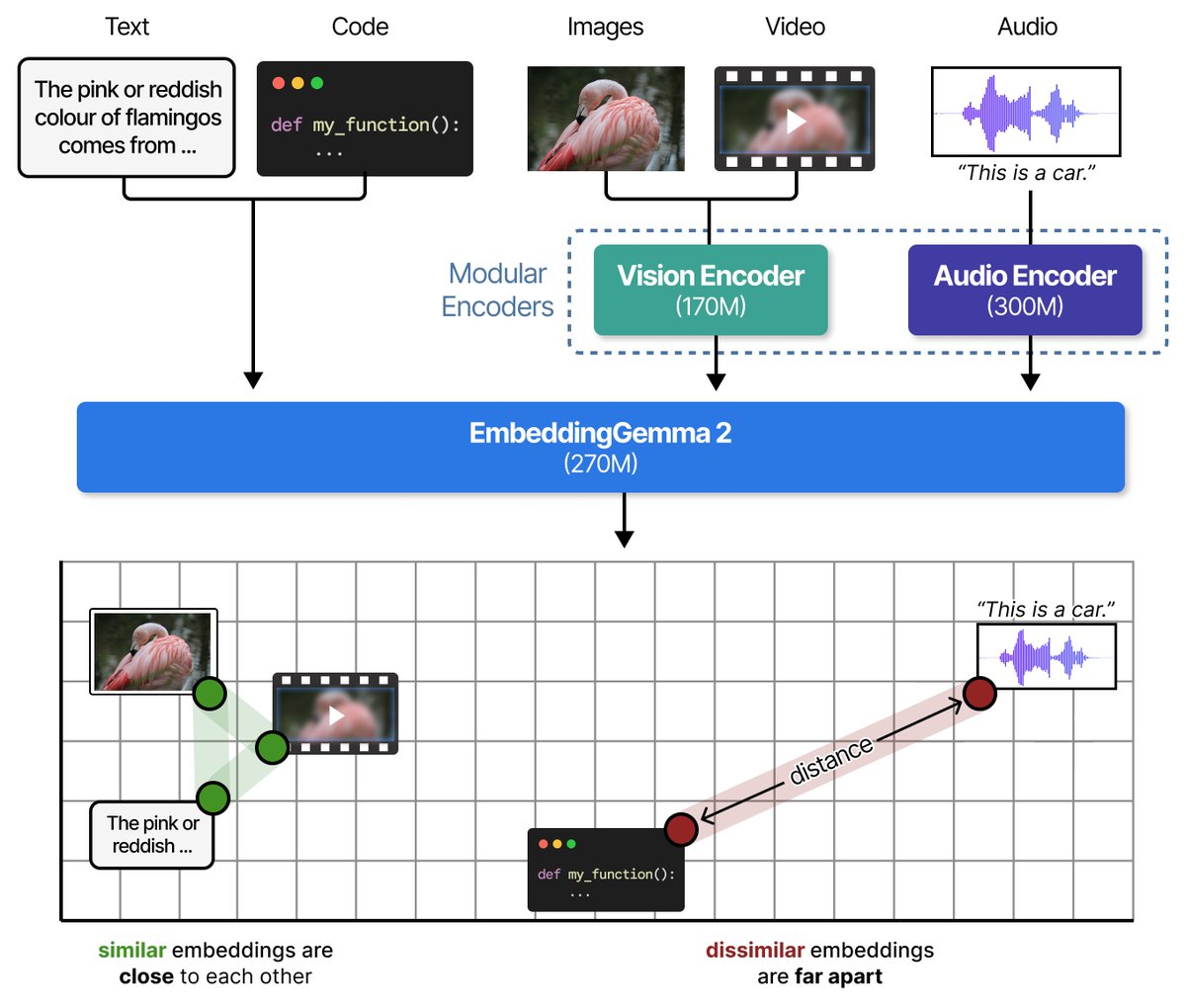
Image credit: Google. Original diagram from its official EmbeddingGemma 2 post, reproduced unchanged. The grid illustrates similarity; the actual embeddings have many more dimensions.
For businesses, this broadens what search can cover: a text question could retrieve a relevant training video segment or image as well as a document. Our assessment is that it also makes local retrieval more practical where connectivity or data handling constraints matter. These capabilities create new options; suitability still depends on testing against your own content, hardware, and access requirements. See Google's model card for specifications and evaluations.
What CIOs should ask before investing
The embedding model is one component of the service. The surrounding data, integrations, and operating process determine whether people can trust and use the results.
Which sources are authoritative? Identify content owners, remove obsolete material, and retain document versions and effective dates. A highly relevant but expired policy is still the wrong result. Updates and deletions must reach the search index.
Who can retrieve what? Enforce the user's permissions when selecting sources, before content reaches an answer-generating model. An embedding is not a security boundary. Treat embeddings, source text, and search logs as business data that need appropriate protection.
How will relevance be evaluated? Assemble representative questions and have business users identify acceptable sources. Measure whether those sources appear among the top results, then assess answer accuracy separately if the system includes RAG. Include ambiguous questions and questions with no valid answer.
What does it cost to operate? Account for initial indexing, updates, storage, search, and any answer generation. Include integration maintenance and human review. Switching embedding models generally requires re-embedding the indexed content because different models' representations are not interchangeable.
What happens when the evidence is weak? The application should make uncertainty visible, show useful sources, or hand the request to a person. Retrieval can support a business decision; approval rules still belong in the workflow.
Start with one measurable business problem
Choose a workflow where people repeatedly search for information and where the benefit of better retrieval is clear. Record the current effort, agree on acceptable quality, and run a pilot with real users and representative content.
Compare the result with your existing search before expanding. The case for investment is stronger when the pilot demonstrates faster work or better decisions, and when the team understands the errors, running costs, and responsibilities involved.
Build your retrieval workflow with AIBackends
AIBackends builds and operates production AI workflows connected to your documents, databases, APIs, and internal systems. We can help scope a semantic search or retrieval application, connect it to your business process, and deploy it in your cloud or private infrastructure with managed support.
Our Workflow Discovery engagement maps the process, data sources, integration requirements, and deployment constraints before defining the implementation scope. We work with open and private models where they fit, with evaluation and access controls built into the workflow.
Bring one search problem, the systems involved, and a measure of success. Get in touch to book a discovery call and turn scattered business knowledge into a workflow your team can use.